Monday, May 27, 2013

Re-ranking the Star Trek movies


So, I finally got to see "Star Trek Beyond," so it's time to do the ranking of all the Star Trek movies. Not much will change this time around.

What the future holds: Despite some reviews, including mine, Beyond was a critical and commercial success. We have definitely not seen the last of Trek. First, in September, the TV series "Star Trek: Discovery" comes to CBS All Access. Most of the movie cast has signed on for one more mission. All I know so far is that Chris Hemsworth will return as George Kirk even though the character died in heroic fashion in the beginning of the 2009 movie, and they will not recast the part of Chekov after the untimely death of Anton Yelchin thanks to the Chrysler Corporation.

SPOILERS AHEAD FOR ALL MOVIES!!!!

Honorable mention: Galaxy Quest (1999)
I know this is not a Star Trek movie, but it might as well be. Egotistical captain played by an egotistical actor, check. Alien who becomes the most popular character in the series, check. Female character who does nothing but repeat what the computer says, check. Rabid fans  (called Questerians) who have blueprints of an entire fictional starship, check. Several cast members, including Wil Wheaton, George Takei and Shatner all thought it was hilarious. Here is Shatner's take, courtesy of Startrek.com:

"I thought it was very funny, and I thought the audience that they portrayed was totally real, but the actors that they were pretending to be were totally unrecognizable. Certainly I don't know what Tim Allen was doing. He seemed to be the head of a group of actors, and for the life of me I was trying to understand who he was imitating. The only one I recognized was the girl playing Nichelle Nichols."

What's good:
  • This is not an all-out parody, like "Spaceballs." There is actually a real story here about the crew of a cancelled science fiction show who is called on for help by an alien race who constructed a perfect replica of the starship from the show. For the record, the movie is really funny and has several laugh-out-loud moments.
  • Great effects for a $45 million movie.
  • Tim Allen is great in the starring role as Peter Quincy Taggart, and seems to bring the essential parts of both the character of Jim Kirk and Shatner himself to this part. 
  • The late, great Alan Rickman almost steals the show as Dr. Lazarus, the cult alien character who tries to be the "serious" actor of the group who has been typecast and thinks this part is beneath him. He later finds out how important his part actually is. 
  • Tony Shalhoub, as chief engineer Fred Kwan, actually gets the funniest moment in the movie when he reports up to the bridge to say, completely deadpan, "Hey guys, I just wanted you to know that, the reactors won't take it; the ship is breaking apart and all that... Just FYI," while the ship is literally breaking apart behind him and crew members are flying around.
  • Sigourney Weaver, as Gwen DeMarco, is aware that she repeats the computer, but feels her job and her inclusion as a woman on the show is important enough. At one point she shouts, "Look! I have one job on this lousy ship, it's *stupid*, but I'm gonna do it! Okay?"
  • Enrico Colantoni, who would go on to become Keith Mars in "Veronica Mars," is great as Mathasar, the leader of the alien species the crew has to save. 
  • Finally, we have to mention Sam Rockwell as the person who shows up randomly and thinks he is the expendable "red shirt" character who dies halfway into the movie.
  • Makes fun of how illogical the TV show can be, particularly during the scene when Peter and Gwen have to go through a hall through of "chompers," which are there for no particular reason, other than to add an element of peril.

What isn't good:
  • Pacing flags on some rare occasions.
  • Will anyone who isn't a Trekker get half of the jokes? (My wife, who most definitely is not a Trekker, seems to think this movie is funny).
Best quote:
Dr. Lazarus: "By Grapthar's hammer... What a savings."


1. Star Trek II: The Wrath of Khan (1982)
Way back in 1979, "Star Trek: The Motion Picture" cost a fortune and had a lot of people leaving the theater scratching their heads. As a result, a new director and writing staff took the series in a whole different direction, and really set the tone for the rest of the movies with the original cast. Most of the credit should go to producer/co-writer Harve Bennett, a TV veteran and Trek novice. His philosophy was that a shorter, more quickly paced movie would appeal to more people. He and director Nicholas Meyer, also new to the franchise, really had a great idea of how to write these iconic characters. Kirk even acknowledges the fact that he is getting old. This is no contest. This has been and probably always will be the best movie in the entire franchise and one of my personal favorite movies. There is a perfect balance of action and character development, a truly heart-wrenching moment (which various movies have tried to recreate with limited success), and the single greatest villain in Trek history (Sorry, Q).

What's good:
  • Despite a modest $10 million budget, the special effects are very good for 1982. The movie's climax still ranks among one of Star Trek's greatest space battles, and the computer animation of the Genesis effect was a breakthrough at the time. (by the way, that animated sequence was done by Pixar.)
  • Nicholas Meyer deserves a lot of the credit for the completely different visual look of the movie. Meyer says he was going for a nautical look for the Enterprise, which included the sets and the sharp red and black uniforms.
  • Ricardo Montalban is perfect as Khan. He is among the all-time greatest movie villains because he is very single-minded in purpose. He is after one thing and one thing only: revenge. He is not looking to conquer the universe. Khan just wants to make James T. Kirk suffer as much as he did.
  • Who can forget the emotional roller coaster of an ending to this film? Even though I know how it is all resolved, it still chokes me up. 
  • Great pacing- A perfect balance between action and character development.
  • The Kobyashi Maru test, and Kirk's approach to it.
  • Kirstie Alley as Saavik. It is interesting to see another Vulcan character besides Spock.
  • The creepy ear things. Ewwwww.
What isn't good:
  • Aside from Kirk, Spock, and McCoy, the rest of the bridge crew isn't given much to do.
  • Uhh... I'm thinking...
Best quote:
Kirk: "KHHHHAAAAANNNN!"

2. Star Trek VI: The Undiscovered Country
Nicholas Meyer (Star Trek II) returns to direct his second film in the franchise, and comes up with another winner. I moved this up! The Nick Meyer films now rank 1-2, because Meyer not only is a good director, but is also a great writer, and the best movies and episodes of the TV series weren't because of special effects or action, but because of great writing, such as "City on the Edge of Forever" (TOS) and "The Inner Light" (TNG). In this case, Meyer and Leonard Nimoy came up with the idea of using the fall of the Klingon Empire as an historical allegory to the collapse of the Soviet Union, and it works brilliantly.

What's good:
  • Meyer once again brings a nautical atmosphere to the Enterprise, giving it a darker, less sterile look, like a big submarine in space. Very effective. 
  • The idea that people are so used to war that Klingons, Romulans and Starfleet personnel are so accustomed to war and conflict that they would conspire together against the peace process is pure genius, and has occurred more than once in our history. Gene Roddenberry didn't like the script because of how prejudiced many of the characters were, and prejudice should be, for all intents and purposes, nonexistent by the 23rd century. I disagree. Everyone is only human and will have these thoughts, even after 300 more years of evolution. What's important is how we are able to overcome these prejudices.
  • David Warner makes a huge impact as Chancellor Gorkon for the short time he's in the movie. He is truly a visionary thinker. By design, the character's name is a combination of Gorbachev and Lincoln, and they even made him similar in appearance to our 16th president.
  • Parts of the dinner scene seemed a bit stiff and forced, but it worked very well overall. 
  • This movie's budget was limited to $24 million because Star Trek V was such a monumental flop. That having been said, the effects were done really well in light of how little money they had to work with, particularly the assassination scene. Now we know what it might look like if someone gets shot in zero gravity. By they way, the blood was a violet color, because use of red blood would have earned the movie an R rating.
  • Sulu becomes the captain of the Excelsior. Takei is the man! By the way, Shatner was opposed to this, because he wanted Kirk to be the only captain in the movie. Also, the Excelsior is one cool-looking ship, and it's great to see it in action. My only question is what happened to James B. Sikking?
  • Among the examples of witty humor peppered throughout the movie:
What isn't good:
  • Occasional use of technobabble to conveniently solve problems. How exactly did they get a torpedo to track down the cloaked Klingon ship? How did Sulu know where the peace conference was taking place?
  • A galley on the Enterprise? What happened to the replicators? Also, why is there an unlocked cabinet full of phasers in the galley? Were they afraid of Klingons stealing all of the Cheetos?
  • I know the scene was there for comic effect, but I agree with Nichelle Nichols that Uhura shouldn't have to consult a book in order to speak Klingon. Also, with the vast array of information that can be stored on computers today, not to mention the 23rd century, why would they even need books in the first place? (This was somewhat remedied in the two latest movies in which Uhura is extremely intelligent and well-versed in Klingon).
Best quote:

Kirk: "Once again, we've saved civilization as we know it."

3. Star Trek Into Darkness (2013)
This latest entry was unbelievably entertaining to watch, but isn't without flaws. It is almost perfectly even with its 2009 prequel, but I give "Into Darkness" the slight edge because this is a visually and technical improvement over "Star Trek." Again, this is a great effort to bring a faster-paced, effects-heavy "Trek" to today's moviegoers. I am a little concerned about the underwhelming opening weekend numbers. This is by no means a flop, but the statistics show that there weren't enough viewers under 25 buying tickets. Therefore, the next movie will be "Star Trek: The Search For a More Youthful Audience." In one of the worst-kept secrets in movie history, an iconic Trek villain is brought back. I am not sure if this was the best idea.

What's good:
  • Top-notch special effects. Also, J.J. Abrams is a great technical director, and a fine choice to direct the next Star Wars film.
  • The whole film moves at a warp-speed pace right from the beginning in an Indiana Jones-inspired action sequence that takes place on another planet.
  • The Klingons are officially back! (they were in a deleted scene from the 2009 movie) Although I like them better as allies than villains.
  • Despite the dizzying pace, Gene Roddenberry's overall philosophy about the true mission of the Enterprise and Starfleet is certainly not lost, especially at the end of the movie.
  • Kirk's character experiences some genuine growth in this movie, and Chris Pine is once again up to the task.
  • I really like what they did with Scotty's character in this movie. Simon Pegg is great in this part.
  • Lots of in-jokes and Easter eggs for hardcore Trekkers, and many moments from a similar scene in a previous "Star Trek" movie are brought back line for line, such as "I think you'd better get down here... You better hurry."

What isn't good:
  • So, the character of Khan Noonien Singh is brought back to the screen once again. Benedict Cumberbatch does a fine job given what he had to work with, but I couldn't really figure out Khan's motivation in this movie. In Star Trek II, he had one purpose and one purpose only: Revenge. Here, we're not sure. I think the script is even trying to get the audience to sympathize with Khan at certain parts of the movie. Yes, he wants to get back at the Starfleet brass who used him, but, honestly, I don't think the character of Khan would allow himself to become anyone's bitch. I think I need to read the graphic novel that accompanies this movie to get some more background on this. Even Nero from the 2009 movie had a clear purpose, which was using Spock as a scapegoat for the destruction of Romulus, so even Nero is a better villain than this Khan.
  • On that note, Khan was a great adversary in "Space Seed" and "Wrath" because of his superior intellect. You didn't see that here, just brute force.
  • I think it might be a little too early for this franchise to hit us with the "death" of a major character. In STII, Kirk and Spock had known each other for 20 years. In this movie the two of them had only known each other for a couple of years. Yes, that is enough time for two people to become BFFs, but some of the emotion during this scene may have seemed a bit manufactured.
  • McCoy is given only a few one-liners. Karl Urban does such a great job with this character, and deserves more screen time.
  • Is there going to be this much lens flare in Star Wars VII?
  • Alice Eve did a good job as Dr. Carol Marcus, but, in one scene, we see her stripping down to her underwear for no particular reason whatsoever. Gratuitous skin would be okay, if not expected, in, say, a Michael Bay movie, but in a franchise that prides itself on strong, smart female characters, this makes no sense. By the way, writer Damon Lindelof has apologized for this.
Best Quote: 

McCoy: "Sweetheart, I once performed an emergency C-section on a pregnant Gorn. Octuplets, and let me tell you, those little bastards bite."

Overall I may seem overly critical about this movie, but I grew up watching Star Trek, and I hold anything that has to do with this franchise to a higher standard. Despite all the nitpicking, this is a very entertaining popcorn movie that is well worth seeing in the theater.


4. Star Trek (2009)

In 2005, Enterprise mercifully went off the air. Rick Berman, who was in charge of the franchise, was given his walking papers. With a clean slate, they asked J.J. Abrams to take over the franchise. Many thought Abrams faced his own Kobyashi Maru test... How do you get mass audiences to theaters and not alienate the fans? Abrams isn't a Trekker, but he hired two longtime collaborators, Roberto Orci and Alex Kurtzman, who are hardcore Trekkers, to write the movie. Abrams did what many thought was impossible... He rebooted the franchise, and made a thoroughly entertaining movie that appealed to fans and nonfans. It grossed a healthy $76.5 million on opening weekend, which is more than Nemesis' entire take, and ended up making an impressive $257 million. Yes, the movie did mess with the "Trek" mythology quite a bit, using time travel trickery to pretty much destroy 50 years of canon, but things needed to be shaken up a lot to revive the franchise, and the movie was good enough for most Trekkers to accept these changes. In the DVD commentary, writers Orci and Kurtzman show that they know a great deal about the franchise, and were very particular on what to change and what not to change.

What's good:
  • Although the movie had tons of action, and was paced more like "Star Wars" than "Star Trek," it still focused on characters, and the story was essentially about the budding bromance between Kirk and Spock.
  • Very good casting for all of  the crew. Chris Pine was outstanding. He thankfully didn't try to imitate Shatner, but had Jim Kirk's swagger and attitude down perfectly. Also, Karl Urban was a perfect McCoy. As Scotty, Simon Pegg is the man! Also, each of the characters were given a defining "moment."
  • Leonard Nimoy as "Spock Prime" was a welcome presence, who provides continuity Yoda-like advice to Kirk and Spock.
  • The new old Enterprise looks great inside and out, but why did they open an Apple store on the bridge?
  • Maintains Gene Roddenberry's optimistic and hopeful view of the future.
  • Odd-numbered curse, be damned!
What's not good:

  • Thoroughly entertaining and visually stunning, but lacks the emotional and narrative depth of the best Star Trek movies and episodes.
  • J. J. Abrams' directing is a little too kinetic at times. And those lens flares!
  • Chekov is only 17 and serving on the Enterprise bridge? I guess he is the Doogie Howser of the 23rd century. (Don't bring up Wesley Crusher, because remember that families were allowed to stay on the Enterprise-D). 
Best quote:
Kirk (to Pike): "You can whistle really loud, you know that?"


5. Star Trek: First Contact
Now that the obligatory passing of the baton was done and over with in "Generations" (see below), Picard and the crew finally get to have fun on their own, and do so in an encounter with the Borg, who try to go back to Earth and alter the timeline just before humans built a ship that reached warp speed and made contact with species from other planets. This is a very entertaining movie, and is unfortunately the only really good movie with the Next Generation crew. How can the same writers who put out the mediocre "Generations" come up with a witty, entertaining and action-packed movie?

What's good:
  • First appearance of the sleek Enterprise-E, and cool new uniforms.
  • Finally, the TNG crew faces a formidable foe worthy of being in a movie. With a movie-sized budget, the Borg look better and more creepy than ever.
  • Picard, who has been a nearly perfect captain and leader for seven years of TNG, finally shows some character flaws, as he seeks revenge against the Borg for the whole Locutus thing. As usual, Patrick Stewart is nothing short of exceptional.
  • Considering this was his first feature film, Jonathan Frakes does a really good job directing. The first shot of the movie is really well-done.
  • Good focus on the characters of Picard, Data and Worf, who sort of emerge as the Kirk, Spock and McCoy of TNG. The altercation between Picard and Worf, and its resolution, are perfectly scripted and very believable.
  • The best guest cast of just about any of the movies:
    • James Cromwell is great as Zefram Cochrane, the inventor of warp drive, and a major historical figure in the Trek universe. In this movie we find out he is far from perfect, and enjoys booze and naked women. This is a great example of how we treat our historic figures like gods, even though, in many cases, they were just ordinary people like the rest of us.
    • Alfre Woodard is also very good as the awe-stricken innocent bystander, and has genuine chemistry with Patrick Stewart. And she thought the Borg were Swedish.
  • I loved the zero-gravity action scene on the deflector dish.
  • Two words: "Assimilate this!"
What's not good:
  • Okay, so the Borg ship creates a temporal vortex, and the Enterprise is caught in its wake, sending both ships back in time. While they are in the past, they destroy the Borg ship. At the end of the movie, Picard nonchalantly orders his crew to re-create the temporal vortex, which happens instantaneously, and sends the Enterprise back to the exact moment they left. Seriously, they made it that easy? In Star Trek IV, they nearly flew the ship apart as they flew around the Sun. So, I guess this means with this knowledge, any starship will be able to time travel whenever they want to. If this is the case, someone should go back in time and tell Shatner not to make Star Trek V.
  • If the Borg are a collective, why do they need a queen? Yes, I know, the answer is that the story was better if the evil in the movie was given a face and identity, but still, the appeal of the Borg is that they are a hive mind. That having been said, Alice Krige was great as the Borg Queen, and she did make quite an entrance.
  • This movie was partially responsible for "Star Trek: Enterprise," which was a shitshow.
Best quote:

Picard: "The reports of my assimilation have been greatly exaggerated."


6. Star Trek IV: The Voyage Home

After the heaviness of Star Trek II and III, producers decided it was time to lighten things up a little bit. A lifeform that looks like a giant kielbasa accidentally shuts down everything in its path and eventually Earth. Despite the fact that the fate of the planet is in the balance, it never seems like anyone in the movie is ever in any actual jeopardy or peril (Although that's kind of the whole purpose of the movie.) The crew travels in time to 1980's era San Francisco, opening the door for countless fish out of water gags and comic mayhem. This was a huge box office success, one of the few times Star Trek was able to appeal to non-fans.

What's good:
  • Thoroughly entertaining from beginning to end. Easily the funniest of the Star Trek movies. Many great one-liners, laugh-out-loud moments, and Spock's deadpan delivery and use of "colorful metaphors."
  • Environmental message is relevant without being heavy handed.
  • Finally, every member of the supporting cast has something to do.
  • Shatner's toupee stays on in water!
  • When Spock gives the Vulcan nerve pinch to an obnoxious punk on the bus blasting his radio.
  • Among the many zingers in this movie:
    • "Double dumbass on you!"
    • "What does it mean, exact change?"
    • "Drilling holes in his head is not the answer!"
    • "Nu-cle-ar... wessels."
    • Back in the sixties, he was part of the free speech movement at Berkeley. I think he did a little too much LDS.
    • 7th Heaven mom: Do you guys like Italian? 
      • Kirk: Yes.
      • Spock: No.
      • Kirk: Yes.
      • Spock: No.
      • Kirk: I love Italian... and so do you.
      • Spock: Yes.
What isn't good:
  • The bizarre scene when the crew goes back in time that looks like a music video for a progressive rock band.
  • I know Scotty is good at his job, but him being able to create transparent aluminum on a late 80's Mac is stretching it a bit.
Best quote:

Kirk (about 20th century America): "This is an extremely primitive and paranoid culture."

7. Star Trek Beyond (Final spoiler alert!!!)

Just saw this. Liked it, wasn't blown away. It was a decent action movie, and nothing more. Although it had some good character moments, It lacked the substance expected from a Star Trek movie. Justin Lin focused too much on ratcheting up the action set pieces, and the rest of the movie fell short. Also, the first screenplay drafted by Simon Pegg (Scotty) was dismissed by the studio as "Too Star Trek-y" and asked for something more accessible like a heist movie or a thriller. Instead, they came up with an action movie. Bottom line - blame the studio.

What's good:
  • Film not only acknowledges the death of Leonard Nimoy and "Spock Prime," but also uses it as a device to develop Zachary Quinto's Spock character. Also, Nimoy and the late Anton Yelchin are both given nice dedications in the end credits.
  • Some easter eggs and fan service, but it doesn't go overboard like Into Darkness. Check out the giant green hand halfway through the credits!
  • Lower budget, but the effects are still better.
  • Focused on the relationship between Kirk, Spock and McCoy. This is one of the elements that really made the original series as great as it was.
  • Paced well, lots of action and fisticuffs. More like a TOS episode than any other movie, and that is a compliment.
  • The Alternative Universe Enterprise gets a cool makeover, and the ultra-advanced 1701-A is beautiful.
  • Allowing all of the bridge crew to recite a line of the famous "These are the voyages" speech is a nice touch. 
  • They actually use "Sabotage" by the Beastie Boys as a weapon of mass destruction! How cool is that?
What's not good:
  • Is a good summer action movie, but lacks the substance of a true Star Trek movie. With Justin Lin directing, it could have been any ol' action movie.
  • Lots of inconsequential and gratuitous action scenes. Kirk riding a motorcycle is a little too much for me. 
  • New characters are hit-or-miss. Kaylah is a tough-as-nails warrior woman, but Krall is a bit predictable. And did we really need that close of a connection to "Enterprise," a show that no one either watched or enjoyed enough to care about?
Best quote:
McCoy: [after removing shrapnel from Spock] Yeah. They say it hurts less if it's a surprise.
Spock: If I may adopt a parlance with which you are familiar, I can confirm your theory to be horseshit.


8. Star Trek III: The Search for Spock

No need to rehash the plot, the title says it all. Don't let the relatively low ranking fool you- this is still a very good and well-paced movie with its share of memorable moments. It's just that the other movies were better.

What's good:

  • Leonard Nimoy has a solid directing debut.
  • Christopher Lloyd, who most people knew back in 1982 as Reverend Jim from Taxi, is a formidable villain as a Klingon who wants the Genesis Device. Keep in mind this is two years before a certain small film about time travel.
  • The scene where Kirk and Co. steal the Enterprise from Space Dock is a blast to watch. 
  • The Excelsior is seen for the first time. What a cool-looking ship. The powers that be actually wanted to make that the new Enterprise before they decided to just bring back the Constitution-class design. However, the Enterprise-B in "Generations" is an Excelsior-class ship.
  • The effects in the scene where the Enterprise is blown up are top-notch. You can actually see the hull melt away, making the inside of the ship visible.
  • Star Trek veteran Mark Lenard returns as Sarek.
What's not good:
  • Any movie would be a tough act to follow after Star Trek II.
  • The movie never has an identity of its own. It seems like an interlude between the adventures in STII and STIV.
  • Non-fans won't have any idea what's going on.
Best quote:
Kirk: "I.... have had... enough of you!"


9. Star Trek: Generations

Here is where we begin to see a major drop in the quality of the movies. Apparently they wanted an official "passing of the baton" from Kirk to Picard. The problem is that Kirk is 75 years older. How do they solve this problem? Create an energy ribbon that not only allows for time travel, but also grants wishes! The story is a mess, but there are enough decent action scenes and character moments to earn this movie a marginal recommendation.

What's good:
  • I have to admit, it is kind of fun to see Picard and Kirk working together.
  • Although the destruction of the Enterprise was handled in a sloppy manner, The crash landing of the saucer section was a decent action sequence, as was Data's reaction to it.
  • Pacing is not bad, but the nexus scene dragged a bit.
  • Naturally, Shatner gets the best lines, including, "Risk is part of the game if you want to sit in that chair."
What's not good:

  • Kirk's death is contrived, unnecessary and stupid. A character this iconic deserves a better sendoff.
  • The Enterprise's destruction was an obvious excuse to add an action sequence get rid of the Enterprise D. After the beatings they took from the Borg, a Klingon torpedo ended up destroying the ship? I don't think so.
  • The captain of the Enterprise-B, played by Cameron from Ferris Buehler's Day Off, is a bumbling idiot whose sole purpose is to allow Kirk to take charge and look good. 
  • Did they actually think they could use the same shot of the Klingon Bird of Prey exploding and get away with it? Not  with this crowd! I heard people jeering this in the theater.
  • Data uses his emotion chip to develop his character and be the movie's comic relief. Some of the gags were forced and nerve racking. 
  • Who the hell turned out all the lights on the Enterprise?
Best quote:

"I don't need to be lectured by you. I was out saving the galaxy when your grandfather was in diapers. Besides which, I think the galaxy owes me one."


10. Star Trek: Nemesis

Before he became Bane, Tom Hardy is Picard's clone and the bad guy in this movie. As mediocre as this movie is, it's is not the mess that many Trekkers think it is, nor is it the worst in the franchise. However, it was not a good note for the TNG crew to end on.

What's good:
  • Some good action sequences.
  • Pacing is actually not bad. (Supposedly there is an hour of footage on the cutting room floor).
  • Some witty humor sprinkled throughout the movie.
  • The space battle at the end is pretty good, especially when the Enterprise rams the enemy ship.

What's not good:

  • The scene with the all-terrain vehicle on the away mission when they are collecting the B-4 android has Picard acting less like a captain and more like a 15-year-old who drank too much Red Bull.
  • Attempt to make a great villain in the vein of Khan backfires.
  • Attempt to create an emotional moment by killing off a major character also backfires.
  • This movie paid no attention whatsoever to the political relationship and alliance between the Romulans and the Federation in Deep Space Nine, which ended not long before this movie was released.
Best quote:
Data: "I will always be puzzled by the human predilection for piloting vehicles at unsafe velocities."


11. Star Trek: The Motion Picture

I moved this up a little bit. I saw the last half of it on television one night, and actually somewhat remembered liking the story, and disliked Insurrection even more. This movie is slowly paced and doesn't develop characters, but does have a decent science fiction story.

What's good:

  • The plot is not all that bad. If I comprehended it correctly, the Voyager spacecraft launched from Earth learned so much that it became self-aware. Again, an interesting, high-concept plot that was a little ahead of its time.
  • Top-notch special effects for the time. The film had a budget of $48 million, which was huge in 1979. However, the sequel to this movie looked just as good, but had only 1/4 of this movie's budget.
  • The new Enterprise looks great. We got a close look at it, because 10 minutes was spent on sweeping shots of the ship's exterior.

What's not good:

  • Painfully sluggish pacing at times. People call this movie the Slow Motion Picture for a reason. Could have easily been 30 minutes shorter.
  • Character development? What's that?
  • Lots of technobabble.
  • Uniforms look like pajamas.
Best quote:

McCoy: Why is any object we don't understand always called "a thing"?


12. Star Trek: Insurrection:

Little more than a television-grade story stretched out to 2 hours and given expensive special effects. The story concerned two species (or so we think) fighting over a planet that supposedly allows its inhabitants to be immortal. Sound boring? It is! Completely forgettable in almost every respect, and reminiscient of the many mediocre episodes of TNG we had to sit through while waiting for the next encounter with Q or the Borg.

What's good:

  • Wow, a captain's yacht!
  • They actually dump the engine core. The first time in the history of the franchise when we do not hear "ejection controls are not responding."
  • Mostly competent acting.

What's not good

  • Sluggish pacing.
  • Riker controls the Enterprise with a joystick?! We're talking about a starship that is a half-mile long, not an F-18!
  • F. Murray Abraham's villain role is little more than high-pitched screaming whenever the Enterprise crew gets away.
  • The subplot with Picard's new girlfriend seems tacked-on, and thanks to Rick Berman (moronic former producer of the Star Trek franchise), they weren't even allowed to kiss.
Best quote:
Picard: "Mr. Worf, do you know Gilbert and Sullivan?"
Worf: "No sir, I have not had a chance to meet all the new crew members since I have been back."


13. Star Trek V: The Final Frontier

Here we are at the bottom of the barrel. Shatner has directed the only Star Trek feature film that is purely unwatchable. The crew meets Spock's half brother (who was supposed to be played by Sean Connery until, I am guessing, he read the script), and they search for God and encounter Klingons. 

What's good:

Occasional laughs, many of which are unintentional.
Some fun "buddy" moments between Kirk, Spock and McCoy.

What's not good:

The plot, the dialogue, the acting, the pacing, should I go on? This is a textbook example of how not to make a movie.
I know it doesn't seem possible, but Shatner is an even worse director than he is an actor.
Row, Row, Row your Boat!
Having to resort to slapstick humor, such as Scotty clanging his head on a bulkhead. Yuk, yuk.
Chintzy-looking and sometimes laughable special effects. The folks at ILM weren't available for this movie, and it shows.
Whaaaaaaa?

Best quote: 

Kirk: "What does God need with a starship?"

Saturday, February 18, 2012

Top 10 movie vehicles!

Now for another stupid and useless top 10 list. If you are a regular reader, you may have noticed that I am a car guy. It's time to pick out the 10 coolest vehicles in movie history, and what makes them great.

Honorable mentions:
Deathmobile, Animal House
Weasley Family Ford Anglia, Harry Potter and the Chamber of Secrets
USS Enterprise(s), various Star Trek movies

10. Wagon Queen Family Truckster, National Lampoon's Vacation
Make/Model: 1983 Wagon Queen Family Truckster
Features:
  • Fuel tank filler conveniently located on hood
  • Eight headlights
  • Driver-side airbag
  • Roof rack that can accomodate luggage and deceased relatives
  • Custom paint job - "Honky Lips" spray painted on rear quarter panel.
Fun facts: This was a Ford LTD wagon deliberately altered to look as obnoxious as possible. The only surviving Truckster sits in an Illinois museum. This movie proves that if you are taking the tribe cross-country, this is the perfect car.


9. Ecto-1, Ghostbusters/Ghostbusters II
Make/model: 1959 Cadillac Miller-Meteor ambulance conversion
Features:
Siren
Pullout rack that can hold four proton packs
Plenty of room for complex ghost capturing equipment.

The filmmakers originally wanted to go with something more high-tech, but you have to admit this car had character.


8. "Eleanor", Gone in 60 Seconds
Make/Model: 1967 Shelby Mustang GT500

Features:
351 cubic-inch Ford Racing Engine, 535 horsepower
Side exhaust pipes (not functional in movie)
Nitrous oxide system (Although a car like this doesn't need NOS, because, as the saying goes, there's no substitute for cubic inches.- This was a big mistake in the movie as far as I am concerned.)

The filmmakers originally wanted Eleanor to be a GT40, but a fleet of these cars would have been prohibitively expensive, so they "settled" for the Shelby. Designer Chip Foose provided the look for Eleanor, and did a great job keeping the original lines of the Mustang intact. Only one actual GT500 was used. The rest of the cars were modified '67 Mustangs.

7. Bluesmobile, The Blues Brothers
Make/Model: 1974 Dodge Monaco Sedan

Features:
Cop motor
Cop tires
Cop suspension
Cop shocks
Runs on regular fuel

Although Joliet Jake didn't like the fact that his brother picked him up from prison in a police car, the Bluesmobile grew on him after jumping an open drawbridge, surviving a chase inside a shopping mall, a 106-mile trip to Chicago, and eluding police through the city's streets before completely falling apart. It may have helped that the car was on a mission from God. If only the cigarette lighter worked... 13 different cars were used for the Bluesmobile, and an on-set body shop was kept open around the clock to repair cars during the movie's production.

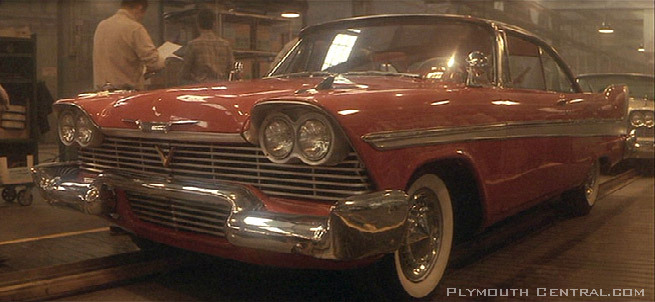
6. Christine, Christine
Make/Model: 1958 Plymouth Fury

Features:
Radio that plays nothing but 1950s music
Possession by an evil, homicidal spirit
Ability to repair its own damage

A fleet of cars was used for this film as well, including the Plymouth Belvedere and Plymouth Savoy. Several Belvederes were destroyed during the film. Fun fact- in the Stephen King novel the movie was based on, the car had four doors. For the movie, this was changed to two doors because there never was a four-door 1958 Plymouth Fury.

5. Tumbler, Batman Begins, The Dark Knight, The Dark Knight Rises?

Make/Model: Wayne Industries Tumbler

Features:
Rear mounted jet engine
Front mounted machine guns
Backend flaps for quick stops
Ejectable 2-wheel "Batpod"

Because the filmmakers deliberately wanted to avoid using CGI for the new Batmobile, the car was built using carbon fiber panels and race car technology to keep the weight down. The 5000-lb. vehicle was able to easily go over 100 mph, and go from 0-60 in 5 seconds. Four of these vehicles were constructed at the bargain price of $250,000 each.

4. Aston Martin DB5, Goldfinger (and several other James Bond movies)

Make/model: 1964 Aston Martin DB5
Features:
Smoke screen
Oil slick
Revolving license plate
Passenger ejector seat
Rear bulletproof shield
Tire-slashing "spinner" hubcaps
Front-mounted machine guns

You gotta love the Q Branch for equipping James Bond with their "specially optioned" cars. The "Wet Nellie" Lotus Esprit in "The Spy Who Loved Me" was pretty cool. The Aston Martin V8 Vantage Volante in "The Living Daylights" was also packed with cool features, and is a close second. The BMWs shouldn't even be mentioned here, nor should the invisible car in "Die Another Day." However, this beautiful DB5 is the original iconic Bond car, and is also the best looking. Fun fact: During the production of "Goldfinger," the producers first approached Jaguar about using an E-Type, but Jaguar declined. The producers then went to Aston Martin, and the rest, as they say, is history.

3. Millenium Falcon, Star Wars Episodes III-VII (Yes, there was a very brief appearance of the ship in Revenge of the Sith).

Make/Model: Corellian Engineering Company Light YT-1300f light freighter (Honestly, where does George Lucas come up with this stuff?)

Features:
2 Gyrodyne SRB42 sublight engines
Series 401 Hyperdrive motivator that can go .5 past light speed (when it works)
Torplex Fore deflector shield generator
AG-2G quad laser cannons
Hidden floor for smuggling spice or people
Landing claw
Hologram game board

Notice this list is called to 10 movie vehicles, not cars, thus the appearance of the venerable Millenium Falcon on this list. I like the way Lucas wanted the ship to have a lot of mileage and wear on it when we first see it, because it adds character. Yet the ship is really sleek and looks built for speed. After all, it did the Kessel run in less than 12 parsecs (Even though a parsec is a unit of distance, not time, but who's counting anyway?) Even though the original "Star Wars" is almost 40 years old, the Falcon going into hyperspace is still a great effect. Fun Fact: The Falcon even decided to lend Starfleet a hand during the battle against the Borg in "Star Trek: First Contact."

2. Bullitt Mustang, Bullitt
Make/Model: 1968 Ford Mustang 390 Fastback

Features:
Smoking rear tires
Ability to catch air on San Francisco streets
Seen on camera going 115 mph or faster

Sorry there are two 1960s Ford Mustangs on this list, but my list wouldn't be complete without this car. As I mentioned on a previous list, the car chase in 1968's Bullitt is the greatest action scene ever. Despite its age, you can't top the precision driving, filming and editing of this scene. Now for the cars. Two iconic American muscle cars duke it out here, as the Mustang chases down the bad guys in a 1968 Charger R/T 440. The dark green fastback is truly a thing of beauty. It is the best looking Mustang ever, and it's no surprise that the current Mustang is inspired by the cars from the late '60s. (Even the current Charger is reminiscient of the '60s body style).

Fun facts:
The suspensions of both cars were beefed up for filming, and both cars were fitted with a roll cage. (My father told me a lot about this movie).
The camera car was built on a Corvette chassis that could keep up with the action.
Steve McQueen wanted to drive the 'Stang himself, but pro driver Bud Ekins took over after McQueen, an experienced driver, almost ran the car off the road after locking up the wheels.
The Charger was a little bit more powerful than the Mustang, so the crew had to modify the transmission and bore out the engine to give the Mustang a little more oomph.

1. DeLorean DMC-12 time machine
Make/Model: 1981 DeLorean DMC-12
Features:
Flux Capacitor (it's what makes time travel possible)
Electronic time circuits
Mr. Fusion home energy reactor (garbage powered)
Hover conversion

Doc Brown said it best: "If you're going to build a time machine, why not do it with some style?" The DeLorean had its share of problems, but it still looks exotic and unique even today, especially with the gullwing doors. The crew chose the DeLorean so it would be mistaken for a spaceship in 1955 because of the doors. This movie turned the DeLorean into a collector's item, and saved dozens of these cars from the scrap heap. This legendary car was one of many elements that worked here to create what is essentially a perfect movie in terms of writing, pacing, character development and visuals.

Fun facts:
The DeLorean company was founded by auto executive John Z. DeLorean, who developed the Pontiac GTO and Firebird among several other notable cars. The DMC-12 was built in a factory in Northern Ireland. The factory cost a fortune, and was paid for by the British government, as well as celebrities like Sammy Davis Jr. and Johnny Carson. The first prototype was built in 1976, but, because of delays, engineering problems and budget overruns, the DMC-12 did not go into production until 1981. The company continued to hemmorhage money, and Mr. DeLorean was accused of investing money in the illegal cocaine trade to keep the factory open. He was arrested, but found not guilty because of entrapment. The factory closed in 1982.
As beautiful as the car was, it was fraught with problems on the set. In cold weather, the hydraulics that kept the doors open didn't work properly, causing the doors to sag, so members of the cast hit their heads on the door.
The car was powered by a craptacular 130-hp Peugeot/Renault/Volvo V6, so the car had trouble even reaching 88 mph. This was remedied in the sequels when they built the DeLorean's body on the chassis and engine of a Porsche 911.
The time machine was originally supposed to be a refrigerator, but the filmmakers were afraid that kids would shut themselves inside refrigerators in an attempt to time travel.
After the huge success of BTTF, John DeLorean wrote writer Bob Gale a thank you letter for immortalizing his car.

Friday, January 27, 2012

I drove Fords!

Once again, it's time for my annual pilgrimage to the auto show.

Last year, I have started going to the Pennsylvania Auto Show in Harrisburg instead of the Philadelphia Auto Show. Philly has more of the concept cars and preproduction models, which are really cool to see sometimes, but Harrisburg is closer, it's only $6 to get in (with a coupon), although parking is $10. Also, there seem to be about 6 million people at the Philly show, many of whom are rude big-city types. The show in Harrisburg still has all of the major 2012 new cars to look at and sit in, it's not nearly as crowded, and it gives you more of an opportunity to really drive some new cars.

You are probably thinking "What do you mean, drive?" One of the newer trends at auto shows are ride and drive events, in which you take cars for a short spin accompanied by a product specialist. Like the rest of the auto show, this is a non-selling atmosphere, so there is no pressure to buy a car, but the reps are there to answer many questions you might have. Most auto shows, including Philly, are in crowded downtown areas, so the ride and drive events through city streets, and you are lucky to break 10 mph. In Harrisburg, you navigate the large parking lots around the massive Pennsylvania Farm Show complex, which hosts the largest agricultural exhibition in the country in January.

Last year, I had the pleasure of driving some fine GM products, and a Subaru. This year, Ford is hosting a ride and drive.

I am a third generation GM man, and, with the exception of a Honda I drove in college, I have driven nothing but GM products. I have driven a Pontiac, an Oldsmobile, a Saab, and I currently own a Saturn. See a pattern here? Maybe my next car will be a Cadillac so I can put that division under.

Anyway, I have nothing against Ford. I think their pickup trucks have always been unbeatable. Their cars seem to be attractive and appealing (except for the Flex and Fiesta sedan), and I think Alan Mullaly's "world car" strategy is good for us, but I always thought that little was done to differentiate Lincolns from Fords, rendering the Lincoln division virtually useless, especially because they are equipping Fords with more and more luxury gadgetry. Having seen the 2013 MKZ, this should be changing.

Also, a good friend of mine works as a thermal systems engineer in Dearborn. He is not only brilliant, but also a family man and an all-around nice guy, so I can assume that with people like him working there, they are building some well-engineered cars.

So here are my impressions of the Ford products I test drove. The test drive route went through the parking lots, and then back into the Pa. Dept. of Agriculture property, where you could get somewhat of a feel for the cars, and a chance to open them up.

Ford F-150 Ecoboost: This is the vehicle (or one of the vehicles) that my friend was working on as an engineer. He has my compliments, because this was an impressive vehicle. Like most of the Ford pickups I have driven, it is easy and predictable to drive, very comfortable to sit in, feels smaller than its massive size. This vehicle is considered by many to be a game changer, because it has a twin-turbocharged V6, which puts out 365 horsepower, and a whopping 420 lb-ft of torque, which matches or surpasses most V-8 pickup truck engines. Although not a hot rod, this was certainly fast enough and then some for most pickup truck drivers. The power came on smoothly and relentlessly, and had a surprising amount of low-end torque for a blown V-6. The exhaust note was the only obvious sign that this isn't a V8. The Eco in Ecoboost is not too obvious. The 16 mpg city-23 mpg highway fuel mileage is only marginally better than its V-8 colleagues, but then again, this ia a 5700 lb. vehicle. Ecoboost trucks start at about $25k for a regular cab, but pile on the options, and the price goes way up. The nicely equipped, but not loaded Super Crew I drove was about $43k. Overall, an impressive vehicle, and I think other manufacturers will follow suit with smaller engines in pickup trucks. Supposedly almost half of all F-150s are Ecoboosts, so this new approach seems to be popular.

Explorer: Not quite as impressed with this vehicle. I drove a loaded V-6 model. I have read that the Ecoboost turbo-4 is very slow. I wouldn't call this V-6 model fast, but it was certainly adequate. Handling and steering feel was a little bit pillowy and imprecise, but not to the point where I wouldn't recommend this car to others. However, the Chevy Traverse, which I drove as a rental car last year, has better handling and steering feel, as well as a better powertrain. The interior is class-leading, with soft touch surfaces, and high-tech stuff everywhere. The instrument cluster has an analog speedometer in the center, flanked by two hi-res digital customizable digital displays on either side that can show the tachometer, radio information, trip information, navigation directions, and other information. People who like tech and gadgetry like my younger brother would love this car. I wasn't able to really play with the MyFordTouch system, which Consumer Reports hates because it is too complex and distracts people from driving. I disagree, because people like technology, and like any piece of high-tech stuff, there is a learning curve on how to use it, and once people know how to use it properly, they have no problem with it. Maybe the folks at CR would like the Explorer more if they spent a couple of months with it. Then again, maybe not, because this isn't a Honda or Toyota.

Focus: I felt a lot more comfortable driving this, because I like smaller cars much better than SUVs and other large vehicles, because I can feel the road, and actually feel like I am driving. The Focus is new for this year, and we finally get the same Focus as the Europeans do. This is a very good compact car with plenty of power and good, predictable handling. A lot of cjournalists complained about the dual-clutch automatic, but it felt fine to me, and seemed no different than any other slushbox on the road. They may have worked the bugs out of the tranny for the 2012 model. Still, this would be a blast with a manual. Again, Ford goes for the high-tech crowd with full color displays on the instrument panel and the center console. Very good marketing, because this is aimed at younger drivers who love technology at an affordable price. I was impressed when I drove this car's competitor, the Chevy Cruze, last year, and I am equally as impressed with this car. I give the slight edge to the Ford because of its sharp exterior and interior styling. Kudos to the Americans for two great cars in the competitive compact car market. Next year's Dodge Dart, which looks great, should be equally as competitive. The Corolla and Civic, which have as much personality as a toaster, are now playing catch-up.

Mustang V6: Thanks to some empty roads, and a product rep who was more than willing to let me play around a little, I was able to thrash the hell out of this Mustang. Gone is the boat anchor 4.0 V6, replaced in 2011 by a 3.7 liter V6 with an impressive 305 hp. Simply put, this car is fast. I had it up to 70 in a matter of seconds. It handles really well, and has that balanced feel that only a rear-wheel drive car can offer. I can only imagine what the V-8 is like. For comparison's sake, I drove a Camaro SS last year. That was one of the fastest cars I have ever driven. Although I think it is more attractive than the Mustang, it was hard to see out of, and the car was so low to the ground I felt like I was sitting in a bathtub. Although I drove the V-6 Mustang and the V-8 Camaro, I would give the edge to the Mustang because it's more comfortable to sit in, and has a better chassis with better handling and steering feel.

Other observations from the auto show:

The preproduction 2013 Escape was on display. It's about time, because the Escape was obsolete 5 years ago. However, the current Escape is very trucklike, while the new one is very carlike. (like the Focus, we get the same car as the rest of the world, except it's called the Kuga everywhere else). I am afraid this may turn off customers who are used to the quasi-macho styling of the Escape.

The 2013 Malibu is going for a more sporty look, complete with Camaro-inspired taillights. Unfortunately, I think it's a step backwards styling-wise, because I like the elegance and simplicity of the current Malibu. Still, it looks much better than the thousands upon thousands of the Camcords on the road.

Chevy Volt: There were lots of people crowded around this car to look at it, yet no one is buying them.

Buick Verano: Nice job taking what is basically a Cruze and making look like a Buick. It basically looks like a smaller version of the Regal, and that's a good thing. This is no Cimarron, but a car that is attractive inside and out and reasonably priced.

Buick Regal GS: Stick shift? On a Buick? Yes!

Volkswagen Passat: Good price for a very conservative looking vehicle. This will sell well, since so many people buy Camrys and Accords, it's clearly apparent that Americans like their midsize cars dull as dishwater.

Subaru Impreza: This is new for this year. For some reason, Subaru actually put a less powerful engine in the car. Power decreases from 170 to 148 hp, although the car is lighter and gets better fuel economy. It looks better, but, like most Subarus, the lines are weird and the proportions are a bit off. This will be an also-ran in the compact segment, but will appeal to Subaru's usual clientele of L.L. Bean wearing New England outdoorsy types, college professors and people of a certain sexual orientation.

Honda CR-V: Finally, after several years of boredom (the new Civic) and sheer homeliness (the Crosstour, Acura ZD-X), Honda finally puts out a decent looking car. The new CR-V looks a little bit more macho (I always thought the last CR-V looked like a chick car), And the interior is very nice. I sat in a leather-appointed vehicle with an attractive two-tone brown interior. However, the powertrain is carryover, which may put this car behind in the compact SUV segment.

Friday, November 25, 2011

The 10 best and worst... Christmas/holiday songs!

So it's barely Thanksgiving and two weeks ago, an area radio station made its annual format switch to all Christmas Music. Some of it is great, some of it makes me want to change the channel, and a lot of it makes me want to vomit. Here is the best and the worst of it all. Sorry about the prevalence of funny/novelty songs, but I like a good laugh.

The Best

10. Novelty versions of "The Twelve Days of Christmas": There are many parodies of this song, and most of them are funny. First, we have John Denver & the Muppets with their version (Five... Goooold.... Riiings.... Ba dum dum dum...). Next we have Jeff Foxworthy's Redneck 12 days of Christmas (You might be a redneck if the nutcracker sounds like something you did off of a high dive!) There is also the take on this song by the McKenzie Brothers, two beer-swilling Canadians from Strange Brew. "On the first day of Christmas, my true love gave to me... beer." Or I am sure you have heard "Twelve Pains of Christmas" by Bob Rivers and Comedy Corp, which shows the more painful side of Christmas. I especially like the guy who tries to rig up the Christmas lights... "Now why the hell are they blinking?" However, the best of these has to be Straight No Chaser, an a capella group from Indiana University (supposedly the original group, now IU alums, still performs together and puts on a great show). This popular viral video from 1998 shows the group's hilarious and ingenious take on the song, which, at one point, breaks out into Toto's "Africa." If you don't laugh at this, you probably have no sense of humor.

9. "The Christmas Song (Baby Please Come Home)" by U2: I am normally not a U2 fan (although my wife is), but this is better than their usual fare, probably because they didn't write it. Bono's voice is a good fit with this song.

8. "Winter Wonderland" by the Eurythmics: A good modern spin on a classic Christmas carol, and, a far as I am concerned, Annie Lennox could sing the phone book and it would sound good.

7. "Christmas in Hollis" by Run D.M.C.: A great old-school rap about Christmas in the city. In the video, Santas sleigh with the Cadillac emblem is a nice touch. This song was immortalized in Die Hard. "This is Christmas music!" R.I.P., Jam Master Jay.

6. Happy Christmas (War is Over) by John Lennon and Yoko Ono: Radio stations play this one to death, but this is a poignant and well-written song, and the antiwar message the song conveys is timeless. This 40-year old song has aged awfully well.

5. "Christmas is the Time to Say I Love You" by Billy Squier: Don't laugh! I always enjoy listening to this awseomely cheesy and catchy Christmas rock anthem.

4. "The Nutcracker Suite" by the Brian Setzer Orchestra: I wouldn't call myself a big fan of this contemporary big band, because the band's arrangements are usually so simplistic, you can't tell it's a 21-piece band, and it seems like, frankly, a waste of musicians. Secondly, Setzer himself seems to hog all the solos. Don't get me wrong, Setzer is one of the better guitar players out there, but if there are so many other musicians in your band, let them play. Anyway, this is one of the best BSO tunes because the arrangement actually makes good use of all the band members. Also, the arrangement is jazzy but respectful to Tchaikovsky's original. At about 7 minutes it is neither too short nor too long. And Setzer only hogs a few of the solos.

3. "Peace on Earth/Little Drummer Boy" By Bing Crosby and David Bowie: An interesting combination of old and new that is very touching and well-performed. David Bowie's counterpoint to Bing Crosby's deeper voice works perfectly here.

2. "Santa Claus is Coming to Town" by Bruce Springsteen and the E Street Band: Literally dozens of artists have covered this familiar tune, but this is the best. This hard driving rock version of the song has the distinctive sound of the E Street Band, and is a blast to listen to. The highlight of the song is when the late, great Clarence Clemons (one of the three most important people in the world) starts to Ho, ho, ho, and the Boss starts cracking up while he's singing.

1. "Do They Know It's Christmas" by Band Aid: This was a supergroup of a lot of great musicians from across the pond, and was formed to raise money for starving families in Ethiopia. Keep in mind that this was released months before "We Are the World," which did the same thing Stateside, but with American musicians and a dumb song. This tune, on the other hand, is beautifully written and well-performed, and it sends a poignant message to keep in mind that there are people in the world that are suffering and starving while we eat, drink and be merry.

Now for the fun part... The 10 worst!

10. Old timey holiday songs: YAWN! The stations playing holiday-themed music around the clock don't seem to be in touch with the times and are playing way too much obsolete, outdated music from squares like Perry Como, Gene Autry and Johnny Mathis. Most fans of these crooners are dead, and it's time to play more contemporary arrangements and songs on the radio. I'm not saying all old music is bad... Deano's version of "Rudolph the Red-Nosed Reindeer" isn't bad, and I like Elvis' "Blue Christmas."

9. "Wonderful Christmastime" by Paul McCartney: John Lennon made a great Christmas song, but it's a swing and a miss for his ex-Beatles bandmate. The silly lyrics and outdated synthesizer leave me scratching my head as to why this song still gets so much radio airplay.

8. "Christmas Wrapping" by The Waitresses: It's boring. It's repetitive. It's sung poorly. The lyrics, about a girl who is lacking in Christmas spirit until she meets the man of her dreams, are inane. Need I say more?

7. "Christmastime" by the Smashing Pumpkins: I don't know what's worse here- the nervewracking melody or Billy Corgan's whiny voice.

6. "Last Christmas" by Wham!: I usually don't mind George Michael. I think "Faith" is a great song, and even "Wake Me Up Before you Go-Go" is catchy in its own way. This synthesized nightmare, however, is poorly written and the lyrics are hilariously awful. It's still not as bad as the "Wham Rap."

5. "Christmas Conga" by Cyndi Lauper: Seriously? Truly the worst of the '80s.

4. Any Christmas carol sung by barking dogs or meowing cats. Whose idea was this, anyway?

3. Anything by the Trans-Siberian Orchestra: Someone came up with the horrible idea of combining heavy metal with Christmas carols, and voila! You have a musical abortion called the TSO. Walter Murphy tried a similar approach with disco and classical in the 1970s with the abominable "A Fifth of Beethoven," and that didn't work either. (However, Murphy has redeemed himself by writing the score for "Family Guy.") Nevertheless, gullible people still buy the TSO's albums, and their concerts still sell out. Many people say they like the pyrotechnics, which, as far as I am concerned, is a way to divert attention from the sheer awfulness of the actual music. Can it get any worse than this? Yes, as a matter of fact, it can.

2. Anything by Mannheim Steamroller: Here's an even better idea: Let's take Christmas music, and make it into boring, pretentious, self-indulgent New Agey dreck! This group's albums also sell, probably because people need a cure for insomnia. Can it get even worse than this? You bet!

1. Any Christmas song by Kenny G: (no links posted deliberately! no one should be subjected to this!) The world's most annoying, overplayed and overpaid musician ruined real jazz for everyone by helping to create the "soft jazz" genre. Pat Metheny, who I am not a particular fan of, hit the nail on the head when he called Mr. G.'s music "dumbed down and f---ed up." When he unleashed his musical butcher knife on Christmas classics, the result is as horrible as you would expect.


Sunday, June 19, 2011

The 10 greatest... Movie action scenes!

I am an action movie junkie! Action is my favorite genre. I appreciate a good movie with a good script as much as the next person, but I am just as happy seeing a brainless action movie that forgets some of the finer points of moviemaking such as character development and a coherent plot. Granted, there are some action flicks with great scripts (Die Hard, Face/Off), but we all know that many of them are simply pointless fun (the entire Jerry Bruckheimer catalog). Here are what I think are the greatest action sequences in movie history. What makes a great action sequence? For the most part, it is great directing and great editing. It has to keep the viewer's attention, and be paced well. It can't just be a sequence of quick cuts and endless explosions (this means you, Michael Bay)! Also, the scenes I have chosen depend more on great stuntwork as opposed to endless CGI (although there are exceptions on this list). That is why I didn't choose, for example, the podrace from Star Wars Episode I or anything from the Transformers movies. The D-Day invasion from Saving Private Ryan is an impeccably directed and staged sequence, but it was based on a true event in which thousands of soldiers died, so I couldn't in good conscience include it on this list. Instead, I stuck to films in which the primary purpose is entertainment. I think I have a good mix of old and new movies, and lots of different types of scenes. It was hard to narrow this list down to 10 scenes, so I copped out and threw 5 honorable mentions on here. Also, before you respond, fanboys, I didn't forget the Matrix movies. They are deliberately not on here because the movies are overrated garbage. Finally, if you haven't seen these movies, don't read on, because I will be spoiling the plots for all of these movies.


Honorable mentions:
Star Wars Episode I (1999): The lightsaber battle (Duel of the Fates): The podrace may not be on here, but this scene is! This sequence was one of this movie's only redeeming qualities. This two-on-one fight happens to be the best lightsaber battle in the entire Star Wars saga, mostly because of great choreography and the martial arts prowess and swordfighting ability of Ray Park (Darth Maul). Watching him swing that double-bladed lightsaber and move so quickly and effortlessly without the aid of special effects is truly a sight to see. John Williams' score and the setting, especially when each of the three adversaries are trapped between deflector shields and are separated from each other, work perfectly here. Although Liam Neeson's character buys it, the payoff at the end is great as Darth Maul meets a gruesome ending. Let's just say he had to split.

The Blues Brothers (1980): The Chicago car chase (Props to my brother here): Sorry, the video clip is just a small portion of the chase "Use of unnecessary violence in the apprehension of the Blues Brothers HAS been approved." Indeed. This movie cost a fortune to make back in 1980, and it shows here. This deliberately far-fetched chase through the streets of Chicago, including the Lower Wacker Drive, is best known for the amount of property destroyed. Aside from the dozens of wrecked police cars, other highlights of this unforgettable choice are the Good Ol' Boys taking a swim, and the Illinois Nazis taking a long, long fall. How did the Blues Brothers make it through all this? They're on a mission from God! This was a tough call between this climactic car chase, and the outrageous car chase inside the mall, but I went with the bigger and more garish of the chases.

Point Break (1991): The foot chase: You wouldn't think that two guys running after each other would make for a great action sequence, but this is great fun to watch. FBI agent Johnny Utah (Keanu Reeves) is chasing a bank robber wearing a Ronald Reagan mask, who also happens to be his surfing buddy Bodhi, played by the late, great Patrick Swayze. This chase goes through a residential neighborhood, running through backyards and even houses. Among the highlights are Keanu drop kicking an angry dog, and the iconic scene where Johnny can't bring himself to shoot Bodhi, so he empties his gun into the air. Great use of hand-held cameras to give the scene a kinetic feel without being too shaky (The now popular "shaky cam" is one of my biggest movie pet peeves). The hilarious parody/comedy "Hot Fuzz" does a great job paying tribute to this scene.

Aladdin (1992): The Cave of Wonders: (Sorry, Spanish dub was all I could find). This movie came out in the middle of Disney's animation renaissance, before everyone got tired of the Disney "formula." This is 2-D animation at its finest, and this particular scene adeptly combined 2-D with some 3-D and CGI elements, which were state of the art back in 1992. The fast-paced scene never lets up, and can hold its own with many great live action scenes. It is part of what is an overall great movie, one of Disney's finest.

Terminator 2: Judgment Day (1991): The Aqueduct chase: The old-school T-800 Terminator (Arnold is a good guy this time), riding a Harley, rescues John Connor from the deadly T-1000 driving a big rig. Great directing, pacing and stuntwork, especially the motorcycle jump into the aqueduct. I can't get over how cool it is to watch Schwarznegger cock a shotgun with one hand. Also, when the truck explodes at the end of the scene, the movie actually explains how the truck blows up (a live wire comes in contact with spilling gasoline). One of my pet peeves in movies is how cars or trucks always seem to explode like a Ford Pinto whenever they collide with something.

And now, the actual Top 10 list:

10. Spider Man 2 (2004): The runaway elevated train: Spidey and Doc Ock are fighting on, around, in and under an NYC elevated train. At one point, Spider Man even surfs on the street between cars. Obviously a lot of CGI needs to be used here, but it is never obvious. The effects are absolutely flawless here, as they should be for the $200 million budget. The fight is dizzyingly fast, but it is choreographed and directed well so you always know what is going on. Then, Doc Ock jumps off, leaving Spider Man to stop the train before it plunges off the tracks into the river. Spider Man eventually uses his web to stop the train, and uses so much energy he ends up unconscious. The train stops and the viewers can breathe once again.

9. The Incredibles (2004): Dash chase scene: Dash and Violet are laying low and waiting for their parents until a robotic bird alerts the authorities, and the badguys in round floating vehicles with blades pursue Dash, who is able to run really, really quickly. Director Brad Bird pushes the limits of what can be done in animation, and there are several action set pieces here that are more exciting than most live-action movies. In my opinion, this is Pixar's best movie so far, and, believe me, that is saying a lot. Maybe that is why Brad Bird was chosen to direct the fourth film in the "Mission Impossible" series.

8. Casino Royale (2006): Parkour!: No invisible cars or mountain fortresses here. This unbelievably good film is a return to pure James Bond, the Bond from Ian Fleming's novels who is brutal yet vulnerable. In addition to a great character-driven screenplay and a nuanced performance by Daniel Craig in his first appearance as 007, this also boasts the best action sequence in any of the 22 "official" James Bond films (again, that's saying a lot). This free chase sequence in which 007 pursues bomb maker Mollaka through a Madagascar construction site is almost entirely done with physical effects and stuntwork, and is riveting from beginning to end, especially when they are on the cranes that are suspended over top of the site. It is also interesting to see Mollaka's and Bond's different methods of getting from place to place. For example, Mollaka jumped through a small hole in a piece of drywall, followed by Bond who literally ran right through the wall. This sequence was co-directed by famous free runner Sebastien Foucan, who played Mollaka. Finally, the hilarious parkour scene in "The Office" was inspired by this movie.

7. Back to the Future Part III (1990): The steam locomotive: (video clip is just the end of the scene) Yes, I love the Back to the Future movies, but I chose this because it has all the ingredients for a great action sequence: Great directing, great pacing and great stuntwork. In the Old West, Doc Brown (Christopher Lloyd) and Marty (Michael J. Fox) are trying to accelerate a steam locomotive to 88 mph, so the DeLorean time machine can return to 1985. Meanwhile, Doc is trying to climb to the DeLorean when, all of a sudden, his girlfriend Clara (Mary Steenburgen) shows up, all hell breaks loose when the boiler explodes, and lo and behold, the Hover Board saves the day! The whole sequence takes more than 15 minutes to unfold, and every second of it is suspenseful. It's impressive to see the stuntmen climbing back and forth on a speeding locomotive, the wreck at the end of the scene is a great use of miniatures, and the audience gets a good laugh when Marty returns to 1985 and crosses "Eastwood Ravine." All in all, a great way to end the trilogy.

6. North by Northwest (1959): The Crop Duster: To this day, film students analyze the pacing, editing and directing of this iconic scene from what I think is Alfred Hitchcock's best movie. The scene starts out with wide shots as Roger Thornhill (Cary Grant), an advertising executive who suffers from a case of mistaken identity, waits in the middle of the field to supposedly meet the person who he is mistaken for. Instead, a biplane buzzes him, then starts to fire automatic weapons. Again, the directing and editing here is perfect, especially the rear-projection shots of Cary Grant with the plane behind him. Also, Hitchcock made the perfect choice to go without any score here (even with the legendary Bernard Hermann working on the film), instead letting the plane's propeller and weapons fire provide all of the sound for the scene.

5. Lord of the Rings: The Two Towers (2003): The Battle of Helm's Deep: Part 2 is here. I said I would stay away from CGI-heavy sequences, but this is so groundbreaking and executed so well I had to include it here. An army of 10,000 Uruk-Hai attacks the final stronghold for Aragorn (Viggo Mortensen) and the people of Edoras. A massive battle ensues, arrows and swords fly, and Legolas (Orlando Bloom) surfs on his shield. It looks like it's all over until Gandalf (Ian McKellen) shows up with reinforcements, sending the Uruk-Hai fleeing. WETA, a special effects company from New Zealand manages to outdo ILM (George Lucas' widely used and award-willing special effects house) with this scene, using a program that animates 10,000 different characters, with each character moving and acting individually. This program is now used often (Joss Whedon used it in the series finale of "Buffy"). This battle has to be seen to be believed, and it needs to be experienced on the big screen. I envy the people who got to see the extended edition in theaters on June 21. Also, great stuntwork is put to good use. This was one of many mind-blowing scenes in this already classic trilogy. Hopefully the upcoming movies based on "The Hobbit" will be just as good.

4. Indiana Jones and the Temple of Doom (1984): The Mine Cart Chase: Talk about scenes that don't let up. This is the cinematic equivalent of a roller coaster ride. Indy (Harrison Ford), Shorty and that annoying woman who Spielberg married are hurtling down a twisty, hilly track, and are trying to outrun the Thuggee guards. The cart almost flies off the track, goes over a jump, and when they finally bring the cart to a stop, a deluge of water almost drowns our heroes. This sequence, like the original Indiana Jones trilogy (I won't even talk about that abomination that "Crystal Skull" was), is a nonstop ride that doesn't seem to end.

3. Star Wars Episode IV (1977): The Battle of Yavin: Part 2 is here. I have watched this movie countless times as a child and an adult. This legendary film was the beginning of my love affair with movies. I pretty much have this entire movie memorized. The climactic scene in which rebel fighters maneuver a trench to fire a torpedo into the Death Star is still exciting to watch, even after the 300th time. The idea of staging this battle in the style of a military dogfight is perfect, and the editing and pacing are impeccable. People had never seen anything like this in 1977 and were absolutely blown away by the images and effects they were watching, and this movie ushered in the era of the special-effects blockbuster which still continues to this day. A lot of purists may disagree with me, but I prefer the 1997 CGI-enhanced special edition of this battle, because you get a better idea of what is going on, and I love that shot as the camera circles around the front of the lead X-wing fighter before the battle begins.

2. The French Connection (1974): The Elevated Train/Car Chase: This legendary scene, in which Popeye Doyle (Gene Hackman) pursues an elevated train in his car works so well because it seems real and not the least bit far-fetched. The stuntwork is unbelievable, and the use of point of view shots (which were filmed by director William Friedkin from the back seat of the car wrapped in a mattress for safety) and the "bumper cam" which showed the chase from low-angle shots which gave an even better sense of how fast the chase actually was. Also, the film crew didn't close off the area before the chase, so actual car and pedestrian traffic was passing through the area, so some of the near misses you see in the movie are actually near misses, and as you will see with the info from the video clip, two unscripted crashes happened.

1. Bullitt (1968): The Car Chase: Simply the greatest ever. I am a car guy, so this was a no-brainer to put the ultimate movie car chase on the top of my list. SFPD detective Frank Bullitt in his Highland Green '68 Mustang pursues a black Dodge Charger R/T. I call this the greatest action scene ever because this chase has it all: Squealing, smoking tires, cars catching air, the real sound of engines revving (no post-production sound looping here), the iconic San Francisco setting, and flying hubcaps (accidental, but the were kept in the film because they looked great), and, last but not least, the King of Cool himself, Steve McQueen. The cars in this chase reached speeds of up to 110 mph, and, simply put, this is some of the best driving I have ever seen. The point of view shots are very effective here as the cars go up and down San Francisco's hilly streets. This movie won an Academy Award for editing, likely because of how well put together this 10-minute scene is. This scene may be more than 40 years old, but it still sets the standard for movie car chases and all action scenes.

Well, that does it. I have probably forgotten something here, so please respond if you have anything to add (unless you are a Matrix fanboy).